Last night I had the tremendous opportunity to attend the New York Metropolitan Opera's premiere of Rossini's Armida. Starring Renee Fleming and directed by Mary Zimmerman, this was not only a stupendous opera, a chance to see the stars on the red carpet, and a delicious evening of food, music, and talent - it was an opportunity to see how a team of true professionals execute a brand-driven partnership with bottom-line results.
For those who know nothing of the opera, don't worry. I can send you some links from the professionals of tone and oration. For those of you who are tired of seeing photos of celebrities like Chloe Sevigny and Maggie Gyllenhaal flood the social blogs, well, that's just part of the realities behind building brand's awareness and securing its position in the hearts, minds, and souls of its clients.
For you branding and marketing wonks, you may want to know that the premier last night was the latest in a multi-year partnership that Yves Saint Laurent created with the Metropolitan Opera. It started years ago when YSL was looking for ways to connect with their clients in an authentic and compelling manner. After looking at its own historic affiliation to the opera, and the passion both its employees and its clients have for the arts, it settled on an unprecedented collaboration to the opera art form via New York's Metropolitan Opera.
The result? Just Google "YSL Armida" - there's 15,700 website links that come up. Google "Yves Saint Laurent Armida" - there's another 16,200 website links. Google "Yves Saint Laurent opera 2010" - 12,800,000 links, and an additional 641,000 links for "Yves Saint Laurent Opera." If you want to see what these 13 million links look like - just click on some of the shortcuts I have added below and ask yourself, how would your brand enjoy this kind of reach and frequency...
So net/net - what's the media value of this? I can't even begin to guess. But this alone is in excess of thirteen million links; and we're not even googling the past operas like Filles Du Regiment that YSL collaborated on in 2009. When you combine the online coverage with the added value of being associated with celebrities like Bette Midler, Christine Baranski, Julianna Margulies, Parker Posey, Maggie Gyllenhaal, Peter Sarsgaard, Patricia Clarkson, Chloë Sevigny, Ginnifer Goodwin, Emily Mortimer, Alessandro Nivola, Camilla Belle, Sid and Mercedes Bass, or Ann Ziff - the result is, well, it's unbelievable.
As important YSL's own internal celebrities - Valérie Hermann (CEO, Yves Saint Laurent), Stefano Pilati (Creative Director), and Laura Lendrum (President - Americas) - were able to reach out and touch the people that truly matter most to the company - their high-end and beautiful clients. Again, what would your company do if it had the chance to actually touch some of your most valuable customers in the flesh?
So to all you marketing wonks out there - take heed when someone tells you it's impossible to reach the high-end, high-value clients in a meaningful way. Take heed when people tell you it's impossible to put a value to event, online, and non-traditional marketing. A partnership like this one, that is created with a brand's true nature in mind, is nurtured through a passionate belief in the core values a brand represents, and extends through direct contact with customer, clients, and prospects can have a real and lasting value to both the brand and the clients.
YSL - well done...
Oh, and for just four of those links ...
http://www.tiny9.com/u/WWD
http://www.tiny9.com/u/sevigny
http://www.tiny9.com/u/camilla
http://www.tiny9.com/u/broadway_world
Jeff Cannon
www.thinkcannon.com
Tuesday, April 13, 2010


Friday, March 26, 2010
Tea Party - Time to Get On Brand
The most recent news about the new Tea Party movement is just so sad; not because of the violence, and the racial slurs that come out of the party, but because of how much opportunity they had to be a real movement of change. Don't get me wrong - I'm not a member of the party or a card carrier on the left. I'm just a guy who liked the fact that a group of Americans had gotten together and had taken action on something they believed so strongly in. Whether it was on the right or the left of the political spectrum - they had started to make a difference.
What makes it sad is that this group has started to turn into something worse than an unruly mob. They went from making valid statements and holding legitimate protests, to throwing bricks through windows and degrading their detractors with racial slurs. When reports sound about Tea Party members using the "N" word against the icons of the civil rights movements - like the 70 year old Emmanuel Cleaver - or the "F" word against gay members of congress, it just shifts the image of Tea Party members away from a being a valid political caucus, over to being a bunch of illiterate bigots. And no, that's not the same thing as being a redneck.
Now I know some people may be saying "that's not us." But when you have Tea Partiers like Amy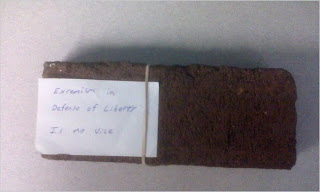 Kremer show up on Fox News to dismiss what she called an "isolated" incident [I'm sorry Amy, it's still NOT OK if only a few are racists - racism is BAD in any number]. Or when you have bricks with misspelled messages coming through the windows of the Democratic Committees [I mean seriously, you can't take 60 seconds to do a quick dictionary check?]. You have to admit, even the Tea Party is taking these actions seriously. It's just a shame they can't stay on message long enough to establish themselves as an informed group.
http://www.nytimes.com/2010/03/26/us/politics/26threat.html?scp=1&sq=brick%20rochester&st=cse
http://www.foxnews.com/politics/2010/03/25/wealthy-donor-sues-tea-party-convention-organizer-palins-fee/
http://www.foxnews.com/politics/2010/03/22/tea-party-protesters-dispute-reports-slurs-spitting-dem-lawmakers/
Jeff Cannon
www.ThinkCannon.com
What makes it sad is that this group has started to turn into something worse than an unruly mob. They went from making valid statements and holding legitimate protests, to throwing bricks through windows and degrading their detractors with racial slurs. When reports sound about Tea Party members using the "N" word against the icons of the civil rights movements - like the 70 year old Emmanuel Cleaver - or the "F" word against gay members of congress, it just shifts the image of Tea Party members away from a being a valid political caucus, over to being a bunch of illiterate bigots. And no, that's not the same thing as being a redneck.
Now I know some people may be saying "that's not us." But when you have Tea Partiers like Amy
 Kremer show up on Fox News to dismiss what she called an "isolated" incident [I'm sorry Amy, it's still NOT OK if only a few are racists - racism is BAD in any number]. Or when you have bricks with misspelled messages coming through the windows of the Democratic Committees [I mean seriously, you can't take 60 seconds to do a quick dictionary check?]. You have to admit, even the Tea Party is taking these actions seriously. It's just a shame they can't stay on message long enough to establish themselves as an informed group.
Monroe County Democratic Committee, via Associated Press
Some have even accused the democrats of infiltrating peaceful Tea Party crowds with plants who shouted the slurs in question. But seriously, the democrats aren't even coordinated enough to keep a majority in the House and Senate. Besides, I don't think the Democrats would shoot out their own glass doors in Phoenix.
So to all the Tea Party acolytes out there - get it together. I may not like everything you say, but you are at least a step toward everyone seeing some kind of ongoing change in Washington. The only thing you have to do is to keep it together and maintain a DIALOGUE that supports the brand and message you started. Yes, it means policing your own and weaning out the racists [nobody said brand management is easy], but if you can do that, you have a chance of making history. If not, you'll be quickly relegated to being just another fringe group of bigoted, angry, and narrow-minded people who are being backed/used by wealthy individuals with larger agendas - which is something this country just doesn't need on either side of the conservative/liberal coin.http://www.nytimes.com/2010/03/26/us/politics/26threat.html?scp=1&sq=brick%20rochester&st=cse
http://www.foxnews.com/politics/2010/03/25/wealthy-donor-sues-tea-party-convention-organizer-palins-fee/
http://www.foxnews.com/politics/2010/03/22/tea-party-protesters-dispute-reports-slurs-spitting-dem-lawmakers/
Jeff Cannon
www.ThinkCannon.com
Tuesday, March 23, 2010
Keeping it Real Lord Winterton
Well, it seems as if one of our brethren in the United Kingdom's conservative party did the unthinkable - he was honest. Technically, Tory, Sir Nicholas Winterton went "off message" when he spoke about not liking to travel with the common man. “They are a totally different type of people,” Sir Nicholas declared in a recent radio interview. He also spoke about the "ghastliness of people in standard-class train cars." "There’s lots of children, there’s noise, there’s activity. I like to have peace and quiet when I’m traveling.”
Now I don't find anything wrong with what he said. Honestly, we would all love some quiet travel time. However, it doesn't really ring true when the Tories have been working so hard to convince their voting Brits that they actually are very much in step with the "common man." Which is why this is less about staying on message, and more about making sure your message is true to heart.
The reality is that no matter how much Sir Winterton rides around on a bicycle - never mind the fact that his limousine followed him, carrying his briefcase, or was educated at Eton - the long established finishing school of the aristocracy and bastion of the wealthy, or married into some estranged arm of the royal family - I lost track of his wife's relation to some long dead king [was "king" supposed to be capitalized?], he is still an aristocratic old man who can scream as much as he likes about enjoying a pint with the working man, but can't escape the truth of who he is.
It is very similar to some of the politico's in these United States that like to talk about being a maverick, or being one with the common man, or bi-partisan, yet still have their hands deep in the pockets of special interest groups and corporate fund-raisers.
So the big lesson here is be true to yourself. If you are, then being true to your message should never be a problem. Nor should being "off message" ever be an issue. All it takes is personal fortitude - which is apparently lacking in most politicians these days. Hmmmmm, perhaps that's the bi-partisan element we've all been seeking in our candidates - personal integrity and fortitude.
So Sir Nicholas Winterton stop trying to pretend. Enjoy who you are and what you have. We all hate screaming kids on our commutes. Take a note from William F. Buckley - and be true to who you are - the truth will eventually come out anyway.
Just be prepared to live the person you really want to be, and accept the consequences for your actions.
Jeff Cannon
ThinkCannon.com
Now I don't find anything wrong with what he said. Honestly, we would all love some quiet travel time. However, it doesn't really ring true when the Tories have been working so hard to convince their voting Brits that they actually are very much in step with the "common man." Which is why this is less about staying on message, and more about making sure your message is true to heart.
The reality is that no matter how much Sir Winterton rides around on a bicycle - never mind the fact that his limousine followed him, carrying his briefcase, or was educated at Eton - the long established finishing school of the aristocracy and bastion of the wealthy, or married into some estranged arm of the royal family - I lost track of his wife's relation to some long dead king [was "king" supposed to be capitalized?], he is still an aristocratic old man who can scream as much as he likes about enjoying a pint with the working man, but can't escape the truth of who he is.
It is very similar to some of the politico's in these United States that like to talk about being a maverick, or being one with the common man, or bi-partisan, yet still have their hands deep in the pockets of special interest groups and corporate fund-raisers.
So the big lesson here is be true to yourself. If you are, then being true to your message should never be a problem. Nor should being "off message" ever be an issue. All it takes is personal fortitude - which is apparently lacking in most politicians these days. Hmmmmm, perhaps that's the bi-partisan element we've all been seeking in our candidates - personal integrity and fortitude.
So Sir Nicholas Winterton stop trying to pretend. Enjoy who you are and what you have. We all hate screaming kids on our commutes. Take a note from William F. Buckley - and be true to who you are - the truth will eventually come out anyway.
Just be prepared to live the person you really want to be, and accept the consequences for your actions.
Jeff Cannon
ThinkCannon.com
Wednesday, March 3, 2010
Today's Realty Shows Have Turned Scripted
Alas - long gone are the days of real outbursts and unplanned snaffu's. Long gone are the talent who really had little idea of what they were getting into. For better, or for worst, today's reality shows are no better than scripted programming. Only now, the directing is being done in the editing bay, and the on-screen talent isn't being paid nearly enough for their performances.
The "realty" brand is truly a brand that has lost its integrity. So, when Real Housewives of New York hits the airwaves again this year, the shame of it is that everyone knows they aren't even from New York City. Nor are they even going to be caught unawares. Instead, they're all feeling their own semi-celebrity. They're all trying to make a splash out of a ripple when the red light of the camera goes on. But the worst part of it is they're not even doing it well. Even shows like Project Runway is bringing in a group of wanna-be celebrities, rather than real designers. The producers have a say in who goes and who stays. So if you ever wonder why sometimes a good designer is "auf weidershened" when a weepy one is kept on. It's their way of directing the drama.
As Lincoln Hiatt - the executvie producer for Solitary on the Fox Reality Channel, calls sleep deprivation "a producer's ally on almost any show."
So that is how they get drama when it's needed. Keep them up later, add some caffeine or bring in the wine.
Gosh, had I known how easy directing is, I would have made a career change much earlier.
But isn't is a shame that the concept of a "reality show" has lasted for less than a few years. Instead, it has moved into the realm of trash - read Jersey Shore. And as the brand goes, so to shall the advertisers and sponsors. A shame, because it could have actually been a goose, rather than a golden egg that is already cracking....
Jeff Cannon
www.thinkcannon.com
The "realty" brand is truly a brand that has lost its integrity. So, when Real Housewives of New York hits the airwaves again this year, the shame of it is that everyone knows they aren't even from New York City. Nor are they even going to be caught unawares. Instead, they're all feeling their own semi-celebrity. They're all trying to make a splash out of a ripple when the red light of the camera goes on. But the worst part of it is they're not even doing it well. Even shows like Project Runway is bringing in a group of wanna-be celebrities, rather than real designers. The producers have a say in who goes and who stays. So if you ever wonder why sometimes a good designer is "auf weidershened" when a weepy one is kept on. It's their way of directing the drama.
As Lincoln Hiatt - the executvie producer for Solitary on the Fox Reality Channel, calls sleep deprivation "a producer's ally on almost any show."
So that is how they get drama when it's needed. Keep them up later, add some caffeine or bring in the wine.
Gosh, had I known how easy directing is, I would have made a career change much earlier.
But isn't is a shame that the concept of a "reality show" has lasted for less than a few years. Instead, it has moved into the realm of trash - read Jersey Shore. And as the brand goes, so to shall the advertisers and sponsors. A shame, because it could have actually been a goose, rather than a golden egg that is already cracking....
Jeff Cannon
www.thinkcannon.com
Thursday, January 28, 2010
Royal Caribbean Still Hitting Haiti for R&R - Niceeeee
Has anyone been keeping up with Royal Caribbean cruiselines? It seems as if they just can't stay away from destroying a tropical paradise with their multi-storied cruise ships - even if it's already been destroyed. I guess ripping up delicate barrier reefs with their anchors, emptying human waste into the oceans, and making a mess of down-trodden local economies just isn't enough to keep those "all you can eat" lunch bar-goers feeling good about themselves. Oh no, they've got to continue cruising into Haiti to make sure their travelers can literally look down on an even more devastated eco-system than they usually do.
Welcome to Royal Caribbean's post-earthquake tour - http://www.nypost.com/p/news/international/ship_of_ghouls_tKJpR6oDf07YZvP7LR2FNP.
As of January 19th, they were still cruising into Haiti, while hundred's of thousands starved, amputated appendages, and died. Hmmmmmm, I don't know about the branding of cruislines in the past, but really. REALLY!!!!
According to NPR, "the CEO of Royal Caribbean International says the company's cruise ships are still arriving in Haiti." HELLOOOO!!!!!!! Despite the fact that the ships have delivered relief efforts to the island, some passengers on the ships are reportedly "sickened" over the decision to dock there. One passenger took to an Internet message board to protest the idea of vacationing where "tens of thousands of dead people are being piled up on the streets, with the survivors stunned and looking for food and water."
I don't even think I have to go into how wrong this is on the business, brand, or even human levels. Seriously, you don't need to hire a PR person, or even a branding expert, to discuss this. It's just simple common sense - and I don't mean the kind that's not that common....
Welcome to Royal Caribbean's post-earthquake tour - http://www.nypost.com/p/news/international/ship_of_ghouls_tKJpR6oDf07YZvP7LR2FNP.
As of January 19th, they were still cruising into Haiti, while hundred's of thousands starved, amputated appendages, and died. Hmmmmmm, I don't know about the branding of cruislines in the past, but really. REALLY!!!!
According to NPR, "the CEO of Royal Caribbean International says the company's cruise ships are still arriving in Haiti." HELLOOOO!!!!!!! Despite the fact that the ships have delivered relief efforts to the island, some passengers on the ships are reportedly "sickened" over the decision to dock there. One passenger took to an Internet message board to protest the idea of vacationing where "tens of thousands of dead people are being piled up on the streets, with the survivors stunned and looking for food and water."
I don't even think I have to go into how wrong this is on the business, brand, or even human levels. Seriously, you don't need to hire a PR person, or even a branding expert, to discuss this. It's just simple common sense - and I don't mean the kind that's not that common....
Thursday, January 21, 2010
Building Your Brand Fabric
Flannel or silk? Cotton or wool? Cut on the bias? Embroidered or embellished with appliqué? What does your garment look like? We have all gone through the exercise of branding 101 by asking, “if your brand were a person, who would that person be?” In today’s market, however, it’s more important to ask yourself, “What would they wear?”
Today, effectively communicating your brand is less about identifying the person your brand represents, and more about identifying how to communicate your brand’s message so that it is well received. While the core of your brand should be true to itself your message should be refined to fit the medium being used. The reason is simple, people change based on what they are doing. They dress casually on the weekend. They ratchet it up a notch or two for work. On a date, they bring out the little black dress or the right jacket. Black tie? A whole different story, altogether. It’s no different in the media. People are more serious when they read the paper. Less so when thumbing through a magazine, and when on Facebook or Twitter, it’s all about two-way interaction.
Think about your own mind-set. It is why most of the world has multiple accounts on dating sites – one for the “playful” side, one for their “serious” side, and one for the “tiger or tigress in everyone”.
Because of this, repeating the same tagline just doesn’t work in today’s media. However, learning how to revise a brand’s message to make the most of today’s media, is akin to looking at a bolt of fabric for its thread, rather than its design. The threads woven into a bolt of fabric are like the media woven into a communication campaign. When Twitter is combined with television, and a Facebook page is interwoven with a newspaper ad, the entire marketing mix produces a richer fabric that sells better.
Because of this, repeating the same tagline just doesn’t work in today’s media. However, learning how to revise a brand’s message to make the most of today’s media, is akin to looking
 at a bolt of fabric for its thread, rather than its design. The threads woven into a bolt of fabric are like the media woven into a communication campaign. When Twitter is combined with television, and a Facebook page is interwoven with a newspaper ad, the entire marketing mix produces a richer fabric that sells better.
 Subtlety is the key to make the garment interesting and appealing to the customer. While they all need to echo the same brand, a Twitter Tweet has to be short, sweet, and pithy. A Facebook page needs to be consistently updated and fun. A print ad needs to be bold, brash and stand out from the news. If one thread is inconsistent, the fabric of your brand starts to unravel, and your customers will quickly see the faults.
When executed correctly your communications will create a gorgeous garment that will look great and sell, whether it is being “worn” online or offline. Just remember, the beauty of your brand lies in the cloth itself and in the way it is woven together, rather than in the person wearing it. So if you are wondering how best to communicate your brand through all the new media opportunities, do what the great fashion designers have done and start with great fabric. Then let it go and empower your customers to show it off everywhere they go. They will pick up the threads of your message and build an even more powerful brand fabric for you.
To learn the five steps to weaving your own brand fabric, email
info@thinkcannon.com.Jeff Cannon
Tuesday, January 19, 2010
30,000 Years of Social Networking
Over the past few weeks I have been reading about different archeological finds, new ways of looking at existing artifacts. Things started popping out at me, that congealed this past weekend - amazing what a day off will do. So bear with me on this, but...
Tens of thousands of years ago Homo sapiens [the first real step toward modern man] created the first knock-offs. These took the forms of fake shells that were found around highland campfire sites. Yes, land-locked ancient humans started creating fake shells out of soap stone, mimicking the shells of far-off tribes. You have to ask yourself why?
It wasn’t New York City's Canal Street where ancient tourists and label-seekers in loin-cloths were looking to buy the latest logo accessory. Or was it? What would make someone, who had to fight every day for survival, take time out to carve a shell bead to hang around their neck? Did they just want to look like a far-off tribe that lived by the sea? The answer is apparently, yes. Call it one of the first forms of social networking. Call it one of the first uses of technology [bone carving tools in that day] to connect with other, like minded people. Technology may have changed, but human nature has not. We have merely changed the technologies we use to keep up with the basic human need to create a community.
Face it, we like other people.
Think about it, back then, early Homo sapiens and Cro-Magnon lived in tribes of perhaps 25 “people.” Each had their own language, as it were, their own signs, and their own look – think fur garments for land-locked tribes, versus reeds for sea-side tribes. When tribes met, they had a pretty quick choice to make. They could make friends or they could fight. So the ability to quickly show another tribe that they were similar and should be friends became a pretty important task. So, when not killing a deer or running from a tiger, making beads to show others they should talk and trade probably ranked up pretty high for anyone looking past tomorrow. They were making beads, not just to show off, but to connect with other tribes, to show others that they were of like minds. Think of how powerful a knock-off bead must have been 30,000 years ago.
Think things have changed? They haven’t. As tribes expanded, the people of the day started banding together under staffs, under banners, under flags. Roll forward several thousand years, to the ancient Greeks. These people grouped together under the banners of city-states like Sparta and Athens. They made treaties, they warred, they died. Then larger societies like Rome came into being. We humans were far from content to be of one people. We created social networks within each of these countries – the rich and powerful separated themselves from the commoners, and well above the slaves by their look and their mannerism.
A better example of this can be found in Rome's upper classes. In the day, they used a purple dye - Tyrian purple – to set themselves apart from other Romans. It was made from glands found in a specific sea snail. Anthroplogist, David Jacoby, remarked that "twelve thousand snails of Murex brandaris yield no more than 1.4 g of pure dye, enough to color only the trim of a single garment." i.e., it was expensive and only a few could afford it.
Apparently it produced a hideous stench, that ancient authors noted, but the cost of producing it was so high, the well to do didn’t care about the smell. What it did was create instant recognition among those of the upper classes, based on how much of a garment was purple. Just trim, or the whole robe? It was one of the first instances of class identification that went beyond country borders. Leaders in other places tried to replicate it with local dyes, with not so great results. But again, it was humans using the latest technology, gland extraction and dye development, to identify and isolate a community within a larger world.
For the next several hundred years, the sense of community has moved away from country borders, and more toward class. Up until about fifty years ago, one’s mannerisms and the way one dressed, spoke, and acted better showed the community one belonged to, than sewing a flag onto a garment. Think - the House of Windsor talking with Nazi Germany - community over borders. But, something happened. The ability to manufacture products at a higher quality and lower cost began to undermine the value of a luxury brand's label. Don't get me wrong, branded labels didn't go away. Instead, the concept of “mixing labels” appeared. People started venturing away from large stores in search of "they're own look". Once again, it was new technology - the ability to travel - that became the new social identifier. "Oh, look what I picked up in Paris..."
Then, along came the Internet, and once again, the technology of social networking changed.
Today, people are using Facebook, Twitter, Linked In, even creating their own, more personal social networks to retain a sense of social order. Don’t get me wrong, the old labels still matter. But new tribes are being formed. Power comes in different shapes today. Look how Twitter has been used among Iranian anti-government intellectuals. See how China is trying to shut down Google as a means to keep its own classes in line. Oh wait, they’re a classless society - oops...
From the day of sitting for hours to carve a single bead, to creating a page on Facebook, to developing a clique within a social network, it has all been a part of the human experience. So why fight it? Those who win, are the ones who learn to use the new technology, who learn to make friends, and who learn to work with a network of like minded people. It is the way humans have always managed to outgrow the competition – whether it lions, tigers, bulls or bears….
They've just turned to SEO, SEM and Keyword marketing...
Tens of thousands of years ago Homo sapiens [the first real step toward modern man] created the first knock-offs. These took the forms of fake shells that were found around highland campfire sites. Yes, land-locked ancient humans started creating fake shells out of soap stone, mimicking the shells of far-off tribes. You have to ask yourself why?
It wasn’t New York City's Canal Street where ancient tourists and label-seekers in loin-cloths were looking to buy the latest logo accessory. Or was it? What would make someone, who had to fight every day for survival, take time out to carve a shell bead to hang around their neck? Did they just want to look like a far-off tribe that lived by the sea? The answer is apparently, yes. Call it one of the first forms of social networking. Call it one of the first uses of technology [bone carving tools in that day] to connect with other, like minded people. Technology may have changed, but human nature has not. We have merely changed the technologies we use to keep up with the basic human need to create a community.
Face it, we like other people.
Think about it, back then, early Homo sapiens and Cro-Magnon lived in tribes of perhaps 25 “people.” Each had their own language, as it were, their own signs, and their own look – think fur garments for land-locked tribes, versus reeds for sea-side tribes. When tribes met, they had a pretty quick choice to make. They could make friends or they could fight. So the ability to quickly show another tribe that they were similar and should be friends became a pretty important task. So, when not killing a deer or running from a tiger, making beads to show others they should talk and trade probably ranked up pretty high for anyone looking past tomorrow. They were making beads, not just to show off, but to connect with other tribes, to show others that they were of like minds. Think of how powerful a knock-off bead must have been 30,000 years ago.
Think things have changed? They haven’t. As tribes expanded, the people of the day started banding together under staffs, under banners, under flags. Roll forward several thousand years, to the ancient Greeks. These people grouped together under the banners of city-states like Sparta and Athens. They made treaties, they warred, they died. Then larger societies like Rome came into being. We humans were far from content to be of one people. We created social networks within each of these countries – the rich and powerful separated themselves from the commoners, and well above the slaves by their look and their mannerism.
A better example of this can be found in Rome's upper classes. In the day, they used a purple dye - Tyrian purple – to set themselves apart from other Romans. It was made from glands found in a specific sea snail. Anthroplogist, David Jacoby, remarked that "twelve thousand snails of Murex brandaris yield no more than 1.4 g of pure dye, enough to color only the trim of a single garment." i.e., it was expensive and only a few could afford it.
Apparently it produced a hideous stench, that ancient authors noted, but the cost of producing it was so high, the well to do didn’t care about the smell. What it did was create instant recognition among those of the upper classes, based on how much of a garment was purple. Just trim, or the whole robe? It was one of the first instances of class identification that went beyond country borders. Leaders in other places tried to replicate it with local dyes, with not so great results. But again, it was humans using the latest technology, gland extraction and dye development, to identify and isolate a community within a larger world.
For the next several hundred years, the sense of community has moved away from country borders, and more toward class. Up until about fifty years ago, one’s mannerisms and the way one dressed, spoke, and acted better showed the community one belonged to, than sewing a flag onto a garment. Think - the House of Windsor talking with Nazi Germany - community over borders. But, something happened. The ability to manufacture products at a higher quality and lower cost began to undermine the value of a luxury brand's label. Don't get me wrong, branded labels didn't go away. Instead, the concept of “mixing labels” appeared. People started venturing away from large stores in search of "they're own look". Once again, it was new technology - the ability to travel - that became the new social identifier. "Oh, look what I picked up in Paris..."
Then, along came the Internet, and once again, the technology of social networking changed.
Today, people are using Facebook, Twitter, Linked In, even creating their own, more personal social networks to retain a sense of social order. Don’t get me wrong, the old labels still matter. But new tribes are being formed. Power comes in different shapes today. Look how Twitter has been used among Iranian anti-government intellectuals. See how China is trying to shut down Google as a means to keep its own classes in line. Oh wait, they’re a classless society - oops...
From the day of sitting for hours to carve a single bead, to creating a page on Facebook, to developing a clique within a social network, it has all been a part of the human experience. So why fight it? Those who win, are the ones who learn to use the new technology, who learn to make friends, and who learn to work with a network of like minded people. It is the way humans have always managed to outgrow the competition – whether it lions, tigers, bulls or bears….
They've just turned to SEO, SEM and Keyword marketing...
Subscribe to:
Posts (Atom)


 Posts
Posts

